
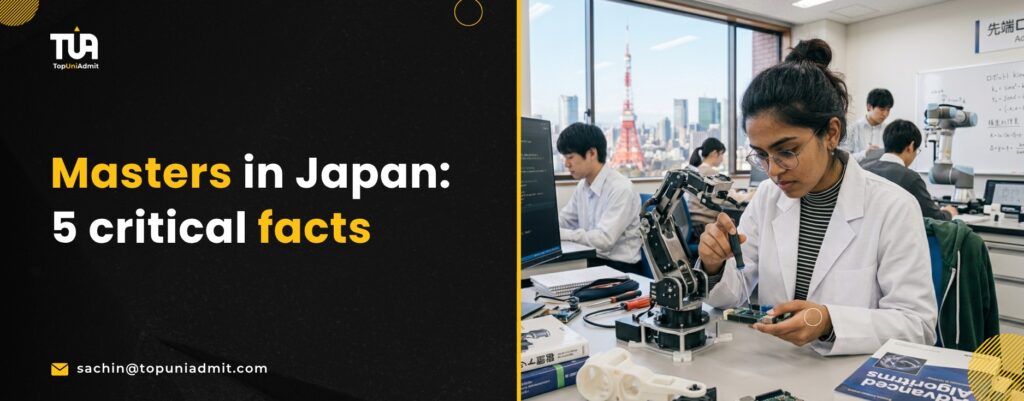
Masters in Japan follow a structure set in national law, and knowing it before you apply changes how you choose a programme. Many B.Tech students assume a Japanese Master’s works like a taught one-year course elsewhere. The Japanese model is two years, research-led, and built around a laboratory.
Here are five facts on how the two years work, each from a Japanese government or university source.
Table of contents
- Fact 1: The two-year term is set by ordinance
- Fact 2: Completion needs credits, guidance and a thesis
- Fact 3: Your laboratory shapes the degree
- Fact 4: There are two entry points a year
- Fact 5: Fees follow the two-year shape
- Planning masters in Japan with us
Fact 1: The two-year term is set by ordinance
Japan’s Standards for the Establishment of Graduate Schools, a Ministry of Education ordinance, set the standard term of a Master’s course at two years. Every graduate school in Japan works inside that rule, national, public and private alike.
The ordinance allows two variations. A graduate school may set a term longer than two years where its education and research need it. And a student with outstanding results may complete after one year of enrolment.
Why planning on two years is safer
The one-year completion is an exception granted on results, decided during the course. For budgets and visa planning, masters in Japan should be treated as a full two-year commitment from day one.
Fact 2: Completion needs credits, guidance and a thesis
The same ordinance sets what completion means for masters in Japan. A student must be enrolled for two years or more, earn at least 30 credits, receive the required research guidance, and pass the review of a Master’s thesis.
Graduate schools may accept a review of research results on a specific topic in place of a thesis where the programme’s purpose suits it. Check which one your programme uses before you apply.
What 30 credits means in practice
Thirty credits is the national minimum. Programmes may set higher requirements and publish them in the programme handbook. Read that handbook for any masters in Japan you shortlist, since it tells you how much of year one is coursework.
Fact 3: Your laboratory shapes the degree
Research guidance is a legal requirement of the course, so masters in Japan are organised around a supervisor and a laboratory. The laboratory is where the thesis research happens, under the supervisor who guides it.
Contacting a supervisor
Some programmes ask applicants to contact a prospective supervisor before applying. Where that is required, the programme guidelines say so. Read that clause first, because the supervisor step can take longer than the application form.
A good match between your B.Tech project work and a laboratory’s research area is one of the strongest points in any application for masters in Japan.
Reading a laboratory page
Before you contact anyone, read the laboratory’s own page: its current research themes, recent publications and the students it lists. Match two or three of those themes to your B.Tech project and say so plainly in your research plan. For masters in Japan, a specific match reads far stronger than a general interest in the field.
After the Master’s
A Japanese Master’s is also the first stage for students who later move into doctoral study. Our post on the PhD in Japan covers what that step involves.
Fact 4: There are two entry points a year
Graduate schools admit in April and in September or October. The University of Tokyo’s Graduate School of Engineering, for example, lists admission dates of 1 April 2027 and 1 October 2027 in its 2027 Master’s application guidelines.
Those guidelines ask applicants to complete 16 years of schooling by the day before the admission date. Twelve years of school plus a four-year B.Tech gives 16.
The 2027 graduate’s timing
A student graduating in May or June 2027 has no degree by 1 April 2027. For that student, masters in Japan start in October 2027, with April 2028 as the fallback. Our post on the MS in Japan intake for 2027 sets out both routes.
Windows open this autumn
One window can serve two intakes. The University of Tokyo Graduate School of Science runs a Special Selection for International Applicants from 15 to 30 October 2026, covering both April 2027 and October 2027 entry. For already-graduated students aiming at masters in Japan next April, this is one of the nearest windows.
Funding runs on the same calendar
Some scholarships are tied to the admission round itself. The MEXT University Recommendation route rides on the university application, so it has to be identified when the shortlist is built.
Fact 5: Fees follow the two-year shape
For masters in Japan, the admission fee is paid once and tuition is paid for each of the two years. At the University of Tokyo, published Master’s figures are:
| Item | Amount |
|---|---|
| Examination fee, first stage | ¥30,000 |
| Admission fee, once | ¥282,000 |
| Annual tuition, Master’s | ¥535,800 |
| Two years, admission fee plus tuition | ¥1,353,600 |
Source: UTokyo admission fee and tuition page, checked 29 September 2026.
¥535,800 is the national standard rate, and each university may set its own figure. Institute of Science Tokyo, for example, charges ¥635,400 a year for a Master’s, according to its tuition and fees page. Living costs, accommodation, insurance and travel sit on top of every line.
Budget both years before the visa stage
The student visa file has to show the course can be funded. No Japanese government body publishes a fixed figure for this, and the assessment is case by case. Our post on Japan student visa proof of funds explains what the documents need to show. For scholarship routes at one university, read our guide to the University of Tokyo scholarship.
Planning masters in Japan with us
Masters in Japan reward students who understand the structure early: two years, a laboratory, a thesis, and an intake chosen by graduation date. Our pillar guide to study in Japan links every other step, and the right intake for masters in Japan starts that plan.
Sachin Gupta runs our Japan desk himself and takes every student conversation personally. Through WebMob he works inside Japan’s technology sector, and he has been to Japan nine times since 2023. Fifteen years leading counselling at Top Uni Admit. Around 175 students placed a year.
As Sachin puts it: “Worth asking any consultant who runs their Japan desk, and whether that person has ever worked in Japan.”
Book a call to match your B.Tech project work to the right laboratories for October 2027 entry.

Sachin Gupta founded Top Uni Admit and runs its Japan desk. He handles every student conversation and every institutional contact for Japan personally. Top Uni Admit has advised Indian students on overseas study for fifteen years across Australia, Canada, the UK, the USA, Germany and France.