
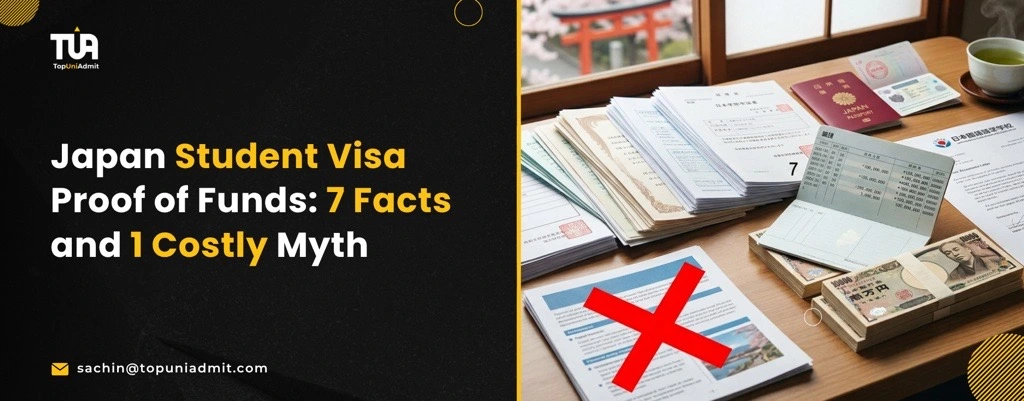
Every family asks the same question, and almost every consultant answers it wrongly: what is the Japan student visa proof of funds requirement, in rupees, right now?
There is no figure. No Japanese ministry publishes one. The number you were quoted came from a university’s guidance note or someone’s guess, and the gap between those sources can be a million yen.
Table of contents
- The law sets a test, not a number
- The ¥2,000,000 myth
- What the documents actually are
- Why Indian applicants sit in a stricter set
- Source of funds, not seasoning
- What immigration says about part-time work
- Where the Certificate of Eligibility fits
- Questions we get asked
Fact 1. The law sets a test, not a number
The governing rule sits in the ministerial ordinance under the Immigration Control and Refugee Recognition Act, for the 留学 residence status. It asks whether the applicant has sufficient assets, scholarships, or other means of support to meet expenses while in Japan. Our six Japan scholarship checks show what each award covers.
Read that again to see what’s missing. No amount. No currency. No mention of a first year, because the test covers the whole period of stay. A third party may carry the cost.
The Study in Japan Official Website, run by the Japanese government, lists what the financial sponsor must produce: a savings balance certificate, an income certificate covering the past year, and documentation identifying the sources of funds. It names documents. It names no threshold. The full Japan visa requirements checklist covers the rest of the file.
The Assessment is Discretionary
Japan student visa proof of funds is judged case by case. Immigration built the rule that way deliberately.
Fact 2. The ¥2,000,000 myth, and where it came from
You will find “around ¥2,000,000 for the first year” repeated across consultant websites and at least one paid course.
It appears in no primary source.
Two university-published guidance figures land near half that:
| Source | Figure | Status |
|---|---|---|
| Hiroshima University | ¥480,000 for six months, ¥960,000 for a year or more | University guidance, not a government rule |
| University of Tsukuba | ¥80,000 per month reference | University guidance, not a government rule |
Where the number probably started
JASSO’s survey puts average total monthly expenditure for Master’s students at ¥160,000, which annualises to ¥1,920,000. That is a record of what students spend. Somewhere it got recast as an immigration threshold, and it has been copied ever since.
If a consultant quotes you a Japan student visa proof-of-funds threshold, ask which government document it comes from. There is no answer to that question.
Fact 3. What Japan student visa proof of funds actually involves
Even without a threshold, you still need substantial paperwork. The financial file runs to:
- A statement of expense payment, on the immigration authority’s own reference form
- Proof of the relationship between sponsor and applicant
- Proof of the sponsor’s occupation
- Proof of the sponsor’s income over the past year
- Bank balance certificate, original
- Documents showing how the funds were accumulated over the past year
- Certificate of scholarship award, where one applies
Two rules that catch people out
Recency. Originals must have been issued within three months. An older certificate gets rejected outright.
Recognised bank. The account must sit with a bank recognised by its national government or central bank.
Fact 4. Indian applicants sit in the fuller documentation set
The dominant variable in Japan student visa proof of funds is not which consulate you use. It is the receiving institution’s classification as a properly-managed school, and your nationality.
Japan’s immigration authority publishes a list of Asian countries and regions exempt from careful examination: Korea, Singapore, Thailand, Taiwan, China, Hong Kong, Macau, Turkey, Brunei, Malaysia, Maldives and Mongolia.
India does not appear anywhere in that document.
You can see the same logic in university instructions. The University of Tsukuba’s pre-arrival page singles out applicants from several countries for extra checks before they begin assembling documents. Indian applicants should plan for more paperwork, earlier.
Fact 5. There is no seasoning period, there is a provenance trail
A second myth travels alongside the ¥2,000,000 one: that funds must sit in the account for six months before you apply.
Immigration does not require funds to have been held for any set number of months. It requires a record of how the money was accumulated, plus a year of proof of sponsor income.
A balance that appeared last week fails on being unexplained, and a clock has nothing to do with it.
A warning worth reading literally
Forged certificates, or a large deposit staged temporarily for the application, taint every application you make after it. Tsukuba puts the same point more plainly: a past refusal makes the next application harder, even with the university acting as your proxy. Our post on Japan visa rejection reasons lists the published grounds.
Fact 6. Part-time work is not a funding plan
Immigration rejects any plan that covers the full cost of tuition and living expenses through part-time work.
That position comes from the Japanese government itself. If the plan is that your child will earn the degree’s cost after arriving, Japan student visa proof of funds ends there.
Fact 7. The Certificate of Eligibility comes first
The Certificate of Eligibility, or COE, is applied for in Japan at a Regional Immigration Services Bureau, usually by a university staff member acting as your proxy. The procedure sits on the Ministry of Justice COE page, and the handling rules on the Immigration Services Agency site.
The sequence:
- You send your documents to the university
- The university lodges the COE application
- The COE is issued and sent to you
- You apply for the visa at the Japanese mission with jurisdiction over your residence
Tsukuba tells its incoming students to allow one and a half to two months for issuance. Build your Japan student visa proof-of-funds file well before that stage, because you can’t produce income and provenance documents retroactively.
Questions we get asked
Does Japan student visa proof of funds vary by consulate? Not in the way people assume. Institution classification and nationality determine the required documents.
Can my uncle sponsor me? Immigration requires proof of the relationship. We haven’t found any government source stating which relationships are permitted, so we can’t confirm it is fine.
Do MEXT scholars still show funds? Tsukuba states that MEXT scholarship recipients do not apply for the Certificate of Eligibility in the usual way. Confirm with your own university.
Is a fixed deposit enough on its own? A balance certificate without the accumulation record is a weak file.
How early should I start? Before the COE stage, and ideally a year ahead.
What we tell students
Japanese immigration law requires you to show sufficient funds for your period of study, and no Japanese government body publishes a figure. Any consultant quoting you a specific rupee or yen threshold is quoting a university’s guidance or their own guess, not a rule. What is required depends on which university admits you, and your university will tell you exactly what to produce.
That answer is harder than a number, and it is the accurate one.
Sachin Gupta runs our Japan desk personally and answers every Japan question himself. The desk opened in September 2026, and we have placed no students in Japan to date, so this is a conversation about your file, not a pitch. Book a call.
For application windows, costs with source dates, and the full funding picture, download the 2027 Japan Admission Guide. If you are a final-year B.Tech student, start with our note on the October 2027 intake, then the rest of our Study in Japan writing and the launch note behind the desk.
We promise information and preparation. Admission and visa outcomes rest with the university and with immigration.

Sachin Gupta founded Top Uni Admit and runs its Japan desk. He handles every student conversation and every institutional contact for Japan personally. Top Uni Admit has advised Indian students on overseas study for fifteen years across Australia, Canada, the UK, the USA, Germany and France.