
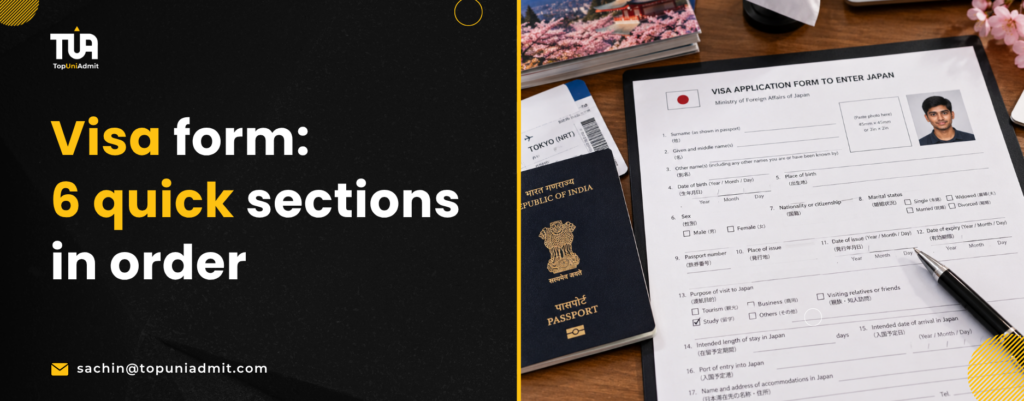
Students often treat the Japan visa application form as the hard part of the visa. With a Certificate of Eligibility in hand, it mostly asks you to copy facts from documents you already hold, and the one field that ties everything together is your COE number.
The form is MOFA’s “Visa Application Form to Enter Japan”, which you download from the Ministry’s visa forms page (dated 9 February 2026) and submit at VFS in India. Below, the Japan visa application form is walked through in six sections, in the order you meet them, with what each one is for.
Table of contents
- Before you start: what the COE already settled
- Section 1: passport and identity
- Section 2: the trip, and where the COE number goes
- Section 3: address, occupation and family
- Section 4: guarantor and inviter in Japan
- Section 5: the six yes-or-no questions
- Section 6: photo, declaration and signature
- A Japan visa application form checklist for the VFS day
- From the Japan desk
Before you start: what the COE already settled
By the time you fill the Japan visa application form, the biggest decision has been made. Your university filed for the Certificate of Eligibility in Japan, and the Immigration Services Agency examined your admission and funding then. Our guide to the Certificate of Eligibility covers that stage.
Why the Japan visa application form is about consistency
The form’s job is consistency. Every name, date and purpose you write should match the passport, the COE and the admission letter. A mismatch is the thing most likely to slow a clean file.
Keep three documents open while you fill the Japan visa application form: your passport, your COE (or its printout), and your offer letter.
Section 1: passport and identity
The opening block of the Japan visa application form is pure transcription. It asks for:
- Surname, and given and middle names, both “as shown in passport”
- Other names you are or have been known by
- Date and place of birth, sex and marital status
- Nationality, plus any former or other nationalities
- ID number issued by your government
- Passport type, number, place and date of issue, issuing authority and expiry date
Dates go in day, month, year order, as printed on the form.
Why “other names” matters: if your school certificates use an initial and your passport uses a full surname, the form gives you a place to say so. Use it, so the officer can match your documents to your passport.
Check your passport validity now
Look at the expiry date before you write it. If your passport expires during your planned stay, renew it first, since every later document will carry the new number.
Section 2: the trip, and where the COE number goes
This block of the Japan visa application form describes the stay itself:
- Purpose of visit to Japan / status of residence. For a Master’s student this matches the status on your COE.
- Intended length of stay in Japan
- Date of arrival, port of entry and name of ship or airline
- Names and addresses of hotels or persons you will stay with
- Dates and duration of previous stays in Japan
- Certificate of Eligibility number
The COE number is the field that links the Japan visa application form to the file the ISA already approved. Copy it character by character from the certificate.
For accommodation, use the address you will hold on arrival, such as a university dormitory if you have one confirmed. Keep the length of stay consistent with your COE and offer letter.
Section 3: address, occupation and family
Next, the Japan visa application form asks about your life in India:
- Current residential address, with every address listed if you have more than one
- Telephone, mobile number and e-mail
- Current profession or occupation and position
- Name and address of employer
- Partner’s profession or occupation, or your parents’ if you are a minor
Write your occupation as it stands on the day you apply. If you graduate in June 2027 and file in the summer, that may no longer be “student”. Your address matters for a second reason: it decides which Japanese mission’s VFS counter you use. Our Japan visa requirements checklist shows which office covers each state.
Section 4: guarantor and inviter in Japan
The Japan visa application form has two parallel blocks, one for a guarantor or reference in Japan and one for an inviter in Japan. Each asks for name, address, telephone, date of birth, relationship to you, occupation and position, and nationality and immigration status.
If the inviter is the same as the guarantor, the form lets you write “same as above”.
Who to list is a question for your university. Ask its international office whom they want named here before you write anything, because their details will be checked against the COE file.
Section 5: the six yes-or-no questions
Six questions on the Japan visa application form ask whether you have ever:
- Been sentenced to imprisonment of one year or more in any country
- Been deported or removed from Japan or any country
- Been convicted and sentenced for a drug offence
- Engaged in prostitution or a related activity
- Committed or aided trafficking in persons
- Been convicted of a crime or offence in any country
The form states that a sentence counts even if it was suspended, and asks for details on any “yes”. Answer every line. A blank reads as an incomplete form. If you are unsure how something in your past fits, our guide to Japan visa rejection reasons sets out the grounds the law lists.
Section 6: photo, declaration and signature
The last part of the Japan visa application form brings it together:
- Photo: pasted in the box, 45mm by 35mm (2in by 1.4in), as printed on the form
- Remarks or special circumstances: optional
- Date of application and signature
The declaration above your signature says two things worth reading slowly. Your status and length of stay are decided when you land in Japan. And holding a visa does not by itself guarantee entry. That is why the landing day matters as much as the VFS day, as our Japan student visa stages post explains.
A consent line also covers an accredited agent sharing your details with the embassy or consulate and paying the visa fee where needed. Read it before you sign.
A Japan visa application form checklist for the VFS day
Run through this list the evening before you go:
- Names match the passport letter for letter, with other names declared
- Dates written day, month, year
- Passport number, issue and expiry dates copied correctly
- COE number copied character by character
- Purpose and length of stay consistent with the COE and offer letter
- Address in Japan filled in
- Guarantor and inviter blocks completed as your university advised
- All six yes-or-no questions answered
- Photo at 45mm by 35mm, pasted in the box
- Form dated and signed
After you submit, the wait is usually short compared with the COE stage. Our post on Japan visa processing time has the full calendar.
From the Japan desk
The Japan visa application form is the last piece of paper in a sequence that starts with choosing the right programme. That earlier choice is where most of the work sits.
“Worth asking any consultant who runs their Japan desk, and whether that person has ever worked in Japan,” says Sachin Gupta, who runs ours and takes every student conversation. Through WebMob, he works inside Japan’s technology sector.
Book a 30-minute call to have your COE details and form checked line by line before your VFS date.

Sachin Gupta founded Top Uni Admit and runs its Japan desk. He handles every student conversation and every institutional contact for Japan personally. Top Uni Admit has advised Indian students on overseas study for fifteen years across Australia, Canada, the UK, the USA, Germany and France.